Delayed payments cost financial institutions and regulated enterprises billions annually. The root cause is often hiding in plain sight: billing statements that confuse rather than clarify. A 2025 study published in JAMA found that wide variation in hospital billing quality directly correlates with payment delays and increased customer disputes.
For banking, lending, and insurance organizations, the operational consequences are measurable: higher contact center volume, unpredictable cash flow, and growing regulatory exposure. This blog covers how monthly statement automation helps your organization eliminate those risks by replacing static, IT-dependent billing with dynamic, personalized communications that accelerate on-time payments.
You will learn what statement automation involves, why personalization at scale matters for billing clarity, and how to implement a governance-ready automation framework. DataOceans provides a structured path to connect billing communications directly to payment outcomes across every channel your customers use.
Key Takeaways: Monthly Statement Automation
- Monthly statement automation replaces manual, error-prone billing processes with governed, data-driven communications across print and digital channels.
- Personalized statements that reflect account-specific details reduce customer confusion and typically increase on-time payment rates.
- Embedded governance controls ensure every automated statement meets regulatory requirements without slowing down delivery timelines.
- DataOceans Statement Manager turns static billing into dynamic customer engagement points that encourage self-service and faster payments.
- Omnichannel delivery coordinated from a single platform reduces print costs while improving digital adoption and customer satisfaction.
What Is Monthly Statement Automation?
Monthly statement automation is the process of using a centralized platform to generate, personalize, and deliver billing statements at scale without manual intervention from IT or operations teams. Rather than relying on spreadsheets, legacy print queues, or fragmented vendor workflows, automated systems pull data from core banking, lending, or servicing platforms and dynamically compose each statement.
The result is a billing communication that reflects accurate, account-specific information and is delivered through your customer's preferred channel (print, email, SMS, or a customer portal) on a consistent schedule. Automation also creates an auditable record of every statement generated and delivered, which is a requirement in regulated industries.
For organizations managing tens of thousands or hundreds of thousands of accounts, this removes weeks of manual effort per billing cycle and establishes a repeatable, governed process that scales as your customer base grows.
Why Does Billing Clarity Drive On-Time Payments?
The connection between statement clarity and payment behavior is direct. When customers understand what they owe, when the payment is due, and how to pay, they act sooner. Confusing statements generate the opposite response: delayed payments, inbound calls to clarify charges, and in some cases, regulatory complaints.
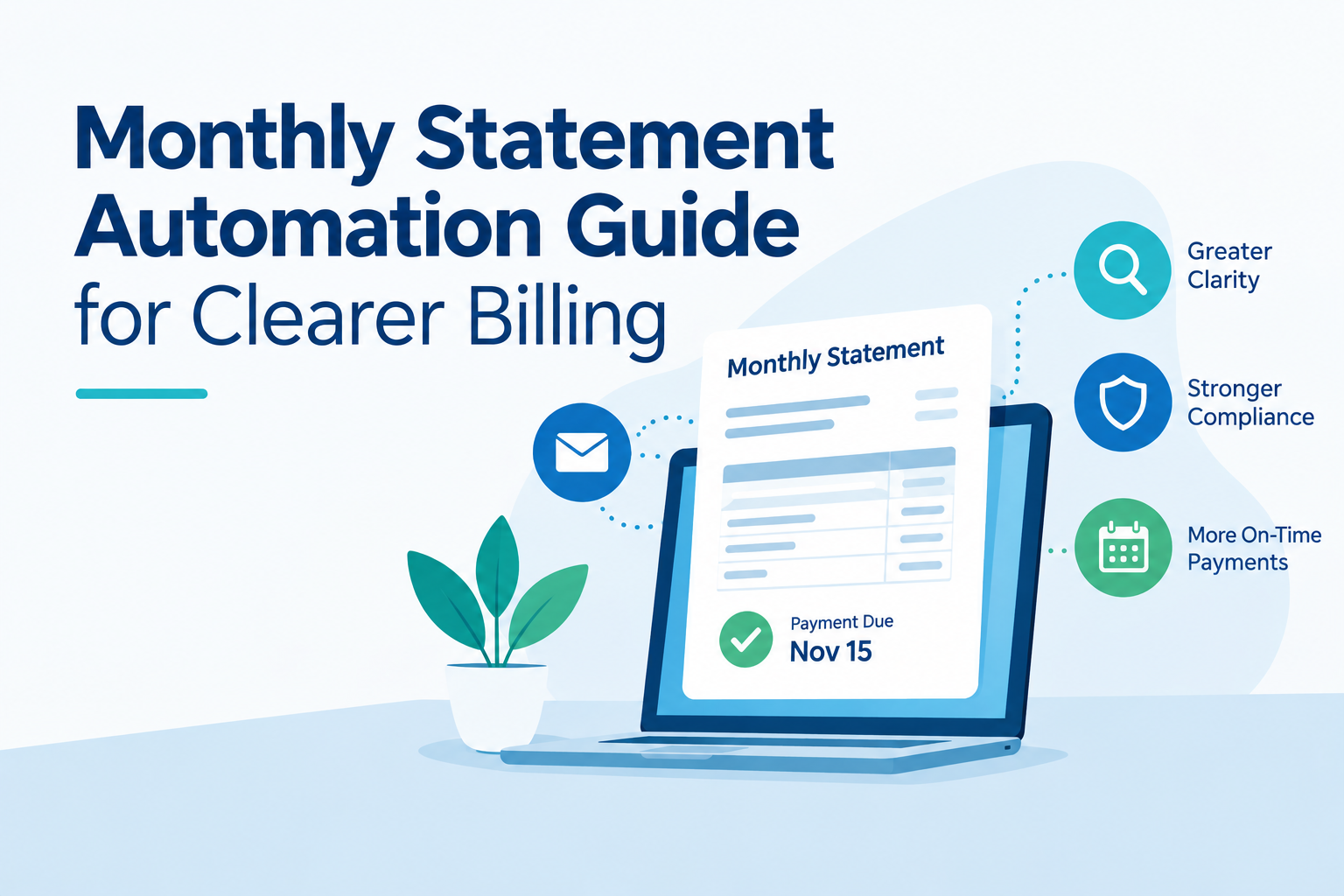
A 2025 billing communication study found that organizations that redesigned their statements for clarity saw a 21% increase in on-time payment rates and a 40% reduction in billing-related customer inquiries. Those outcomes translate directly to lower Days Sales Outstanding (DSO), reduced contact center costs, and more predictable cash flow.
For regulated enterprises, clarity also carries compliance weight. CFPB Regulation Z (12 CFR § 1026.7) requires that periodic statements disclose specific information "clearly and conspicuously." Statements that bury critical details in dense text or confusing layouts create regulatory exposure alongside operational inefficiency.
How Statement Personalization Reduces Customer Confusion
Statement personalization goes beyond inserting a customer's name into a template. At scale, it means dynamically composing each statement based on the customer's account type, balance, payment history, communication preferences, and applicable regulatory disclosures.
When a borrower receives a statement that explains their specific charges in clear language, highlights the exact amount due with the due date prominently displayed, and includes a QR code linking directly to a payment portal, the cognitive effort to complete the payment drops significantly. Personalized statements address the individual context that generic, one-size-fits-all templates cannot.
For institutions managing multiple product lines (mortgages, auto loans, credit cards, HELOCs), personalization also means applying the correct disclosures, regulatory language, and formatting rules for each product type automatically. This eliminates the compliance risk of sending the wrong disclosure to the wrong account.
The Five Components of an Effective Statement Automation Framework
Implementing statement automation requires more than selecting a vendor. It requires a structured framework that addresses data, design, governance, delivery, and measurement. The following five components provide a defensible structure for your organization to evaluate, plan, and execute.
1. Connected Data from Core Systems
Automation starts with reliable data. Your statement platform needs to connect directly to core banking, loan servicing, insurance policy, or billing systems to pull accurate, real-time account information. This means your data composition engine aggregates and normalizes data from multiple sources into a single, accurate view of each customer's account before the statement is generated.
Without connected data, your statements will reflect outdated balances, incorrect due dates, or missing transactions. These errors erode customer trust and increase call volume.
2. Dynamic Statement Design and Personalization
Effective statement automation requires template-based design that supports flexible layouts. Content zones within each template enable personalized messaging, targeted offers, regulatory disclosures, and visual elements like charts and QR codes. The design should prioritize visual hierarchy: the amount due, due date, and payment instructions should appear prominently at the top of the statement.
DataOceans Statement Manager provides configurable templates with dynamic content zones that allow your team to personalize each statement based on account data, without requiring IT involvement for every change.
3. Embedded Governance and Compliance Controls
Every statement your organization sends is a regulated communication. Governance controls must be embedded into the automation workflow, not bolted on afterward. This includes version control for templates, approval workflows for content changes, communication governance audit trails for every statement generated and delivered, and jurisdiction-specific disclosure management.
For consumer lending organizations, this means ensuring compliance with Regulation Z periodic statement requirements, state-specific disclosures, and fair lending communication standards. For healthcare payers, it means accurate Explanation of Benefits (EOB) formatting and HIPAA-compliant delivery.
4. Omnichannel Delivery and Digital Adoption
Your customers have different channel preferences. Statement automation must support coordinated delivery across print, email, SMS, and self-service portals from a single platform. This is not about choosing digital over print. It is about honoring customer preferences while promoting digital adoption through personalized incentives and convenient payment pathways.
Organizations that implement omnichannel statement delivery often see significant reductions in print and postage costs, along with higher customer engagement with digital channels. The key is consistency: the same information, branding, and clarity standards must apply regardless of the delivery channel.
5. Measurement and Continuous Improvement
Statement automation is not a one-time project. It requires ongoing measurement of key metrics: on-time payment rates, digital adoption rates, contact center call volume for billing inquiries, DSO trends, and customer satisfaction scores. These metrics inform iterative improvements to statement design, personalization logic, and delivery timing.
Tracking digital engagement (email opens, portal logins, QR code scans) gives your team visibility into which communication strategies accelerate payment behavior and which need refinement.
How to Implement Monthly Statement Automation Step by Step
Moving from manual or legacy billing processes to automated statement generation requires a phased approach. The following steps provide a practical roadmap.
Step 1: Audit Your Current Statement Workflow
Begin by documenting your existing process: how data flows from core systems to statement generation, which teams are involved, how long each billing cycle takes, and where manual intervention is required. Identify the specific pain points causing delays, errors, or compliance gaps.
Collect baseline metrics: current on-time payment rates, billing-related call volume, DSO, and print/postage costs. These will serve as your before-and-after benchmarks.
Step 2: Define Governance and Compliance Requirements
Before designing new templates, map the regulatory requirements that apply to each product line and jurisdiction. For consumer lending, review CFPB periodic statement rules. For insurance, confirm EOB formatting standards. For utilities, verify state public utility commission disclosure requirements.
Establish a governance framework that includes template version control, content approval workflows, and delivery audit trails.
DataOceans Compliance Hub+, powered by Hudson Cook, provides attorney-produced, legally maintained templates embedded directly into your workflows for faster compliance response.
Step 3: Design Customer-Centric Statement Templates
Redesign your statement templates with the customer's perspective in mind. Place the amount due, due date, and payment instructions at the top. Replace jargon with clear, consumer-friendly language (use "delayed payments" rather than "missed payments," and provide explanatory text rather than code-laden footnotes).
Include dynamic content zones for personalized messaging, cross-sell opportunities, and regulatory disclosures. Add QR codes that link directly to a secure payment portal, reducing the steps a customer needs to complete their payment.
Step 4: Connect Data Sources and Configure Automation Rules
Integrate your statement platform with core banking, loan servicing, or billing systems to ensure real-time data accuracy. Configure rules for statement generation timing, channel routing based on customer preferences, and personalization logic based on account type, balance, and payment history.
Test thoroughly before launch. Run parallel statement cycles comparing automated output against your legacy process to validate data accuracy, formatting, and disclosure compliance.
Step 5: Launch, Monitor, and Optimize
Roll out automated statements in phases: start with a single product line or customer segment, measure results against baseline metrics, and expand. Monitor on-time payment rates, call volume, digital adoption, and customer feedback. Iterate on the template design and personalization logic based on the data.
Organizations that follow this phased approach typically see measurable improvements within the first two billing cycles, with compounding gains as personalization logic and digital adoption mature.
What Role Does Communication Governance Play in Statement Automation?
Communication governance is the operational discipline that ensures every automated statement is accurate, compliant, auditable, and delivered on time. It is not a compliance checkbox. It is a measurable capability that protects your organization from regulatory fines, audit findings, and reputational risk.
Governance in statement automation includes five pillars: content governance (who can create and edit template language), approval governance (who must sign off before changes go live), workflow governance (how statements move through the production pipeline), delivery governance (how channel routing and timing are managed), and audit governance (how every action is logged and retrievable).
Without embedded governance, automation can amplify errors at scale. A single template mistake sent to 100,000 accounts creates a regulatory event.
With proper governance controls, that same template change goes through version control, legal review, and approval workflow before it reaches a single customer. You can assess your communication governance maturity to identify where your organization's current gaps exist.
How Does Statement Automation Support Digital Adoption?
Shifting customers from paper statements to digital delivery is a measurable operational goal: it reduces print and postage costs, accelerates payment timing, and enables richer engagement through interactive content. Statement automation supports this shift by making digital delivery the default experience, with print available for customers who prefer it.
Automated statements delivered via email or portal can include embedded payment links, personalized offers, and interactive elements that static paper statements cannot support. When customers can view their statement, understand their charges, and pay in a single digital interaction, digital adoption accelerates naturally.
DataOceans clients have achieved over 90% electronic adoption of communications within 60 days of going live, with corresponding reductions in print volume and call center activity. The key is pairing digital delivery with clear, personalized statement design that earns customer trust in the digital channel.
How Statement Automation Addresses Industry-Specific Billing Challenges
Statement automation is not a generic capability. The requirements differ significantly across regulated industries. Understanding these differences ensures your automation strategy addresses the specific challenges your organization faces.
Banking and Credit Unions
Banks and credit unions manage multiple product lines (checking, savings, CDs, mortgages, HELOCs, credit cards) that each require distinct statement formats and regulatory disclosures. Automated systems must support consolidated statements that unify multiple accounts into a single communication while maintaining product-specific compliance.
DataOceans CCM for banks addresses this by providing configurable templates and data composition capabilities for multi-product statement generation.
Consumer Lending
Lending organizations face stringent periodic statement requirements under CFPB Regulation Z. Every statement must include specific disclosures about interest, fees, and payment allocation. Automation ensures these disclosures are applied correctly for every account, every billing cycle, without manual review. The volume of consumer finance communications makes manual processes unsustainable.
Healthcare Payers
Healthcare billing is uniquely complex. Explanation of Benefits (EOB) documents must accurately reflect plan benefits, provider charges, member responsibility, and applicable copays or deductibles. A 2025 KFF study found that 27% of insured adults reported that their health insurance paid less than expected for a bill. Clear, automated EOB and billing statements reduce member confusion and related call volume.
Utilities
Utility billing involves variable consumption data, tiered rate structures, and state-specific public utility commission regulations. Automated statement systems must dynamically calculate and display usage-based charges clearly while meeting regulatory formatting requirements. DataOceans CCM for utilities supports these requirements with configurable data composition and delivery rules.
What Metrics Should You Track After Implementing Statement Automation?
Measuring the impact of statement automation requires tracking metrics that directly link the quality of billing communications to business outcomes. The following metrics provide a comprehensive view.
Payment Performance Metrics
On-time payment rate is the primary indicator. Track the percentage of customers paying by the due date before and after automation. Also monitor DSO trends, autopay enrollment rates, and the percentage of payments made through digital channels versus paper checks.
Operational Efficiency Metrics
Measure billing-related contact center call volume, average handle time for billing inquiries, cost per statement (print versus digital), and the time required to complete each billing cycle from data pull to delivery. Organizations implementing statement automation often see a 7% to 15% reduction in contact center activity related to billing inquiries.
Customer Engagement Metrics
Track digital adoption rates (percentage of customers receiving digital versus print statements), portal login frequency, email open rates for e-statements, QR code scan rates, and customer satisfaction scores related to billing clarity. A 75% increase in self-service volume is a documented outcome among organizations that pair automated statements with self-service portals.
Compliance and Governance Metrics
Monitor the number of statement-related compliance exceptions, template approval cycle times, audit finding frequency, and regulatory complaint volume. These metrics confirm that automation is strengthening rather than weakening your governance posture.
In Conclusion: How to Build a Statement Automation Strategy That Accelerates Payments
Monthly statement automation is an operational infrastructure investment that directly links billing clarity to payment outcomes, regulatory compliance, and customer experience. The organizations that treat statements as customer engagement opportunities, rather than static documents, will see measurable improvements in on-time payment rates, contact center efficiency, and digital adoption.
Your path forward starts with auditing your current process, defining your governance framework, and implementing a platform that supports connected data, personalized design, embedded compliance, and omnichannel delivery.
FAQs About Monthly Statement Automation
What is monthly statement automation?
Monthly statement automation uses a centralized platform to generate, personalize, and deliver billing statements at scale. It replaces manual, IT-dependent processes with governed workflows that pull data from core systems and compose each statement dynamically for accuracy and compliance.
How does statement personalization improve payment rates?
Personalized statements display account-specific details clearly: the exact amount owed, the due date, and a direct payment link. DataOceans Statement Manager creates these personalized communications at scale, reducing confusion and encouraging faster payment completion.
What compliance requirements apply to automated billing statements?
Requirements vary by industry. Consumer lenders must meet CFPB Regulation Z periodic statement standards. Healthcare payers must comply with EOB formatting and HIPAA rules. DataOceans Compliance Hub+ provides attorney-maintained templates that stay current with regulatory changes across all 51 U.S. jurisdictions.
How long does it take to implement statement automation?
Implementation timelines vary based on complexity, but most organizations complete the process in 12 to 16 weeks from audit to rollout. DataOceans supports a phased approach, starting with a single product line and expanding as your team validates results against baseline metrics.
Can statement automation reduce print and postage costs?
Automated omnichannel delivery promotes digital adoption by making electronic statements the default. DataOceans clients have achieved over 90% electronic adoption within 60 days, significantly lowering print and postage expenses while improving customer engagement through digital channels.
How does DataOceans help with monthly statement automation?
DataOceans provides a complete customer communications platform that connects your core systems to personalized, compliant statement generation and omnichannel delivery. From statement design and governance to digital portals and payment integration, the platform gives your team business control without IT dependency.