Customer communication is becoming more complex.
Organizations today manage a growing mix of regulatory customer communications, statements, billing communications, payment-related communications, servicing communications, and digital customer interactions.
At the same time, communication channels continue to expand. Customer expectations continue to rise. Regulatory requirements continue to evolve. Many organizations are also exploring workflow automation and future AI-assisted capabilities.
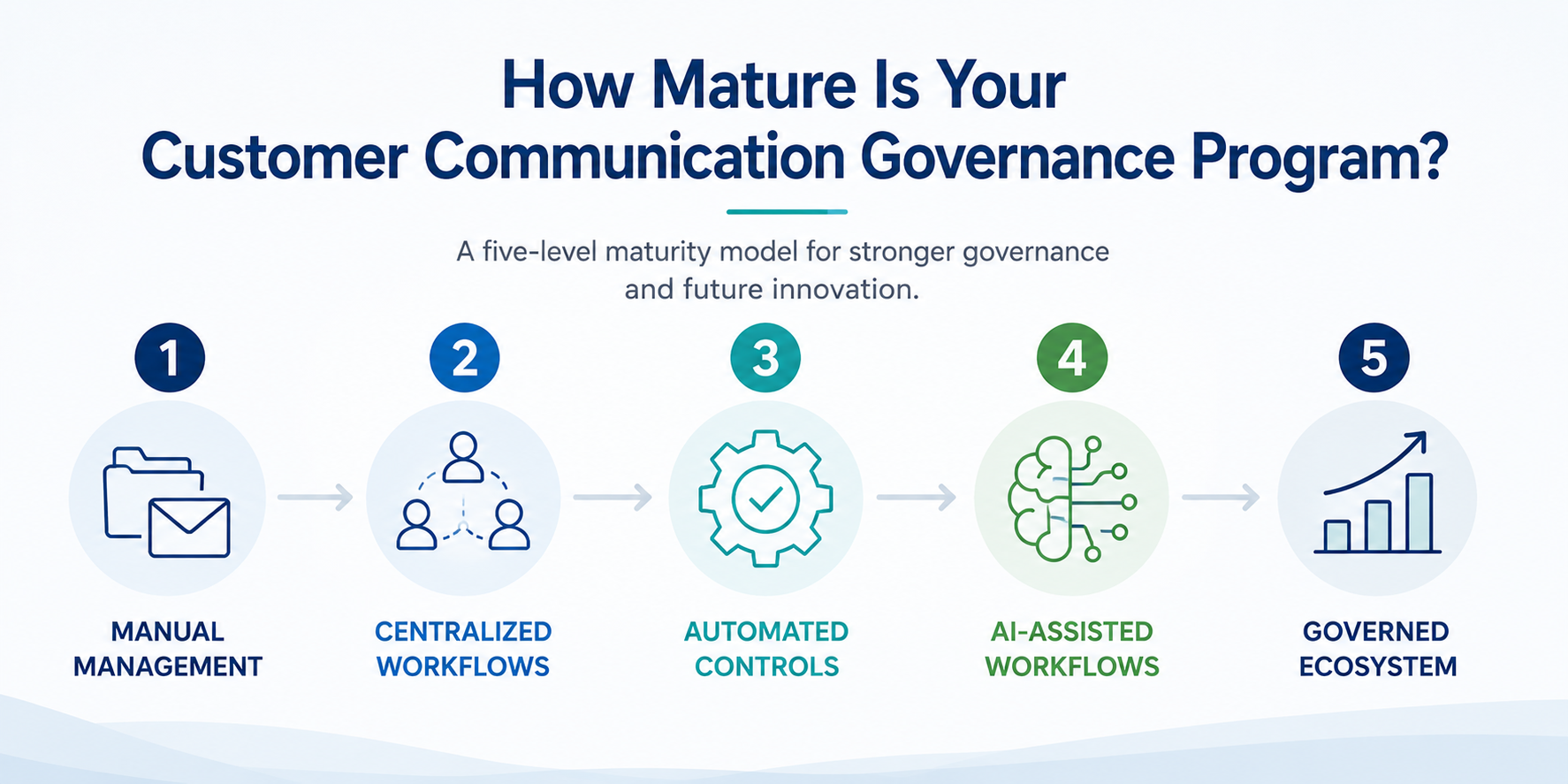
How Mature Is Your Customer Communication Governance Program?
Customer communication is becoming more complex.
Organizations today manage a growing mix of regulatory customer communications, statements, billing communications, payment-related communications, servicing communications, and digital customer interactions.
At the same time, communication channels continue to expand. Customer expectations continue to rise. Regulatory requirements continue to evolve. Many organizations are also exploring workflow automation and future AI-assisted capabilities.
The challenge is no longer simply creating customer communications.
The challenge is maintaining visibility, consistency, and control across the entire communication lifecycle.
This is where communication governance maturity becomes important.
Download our eBook: Governance-Ready Customer Communications in the Age of AI.
Why Governance Maturity Matters
Every customer's communication represents more than a message.
It may also represent a regulatory obligation, a servicing interaction, a payment-related communication, or a documented customer touchpoint.
Organizations are often expected to demonstrate:
- What was communicated
- When it was delivered
- Which version was approved
- Who approved the communication
- How communication records were maintained
As communication environments become more complex, maintaining this level of oversight becomes increasingly difficult without structured governance processes.
The organizations best positioned for future innovation are often those that first establish strong governance foundations.
Communication Governance Is a Journey
Very few organizations build mature communication governance programs overnight.
Most evolve as communication volumes increase, channels expand, and operational complexity grows.
An organization may begin with manual communication processes and email-based approvals. As communication requirements become more sophisticated, governance controls are introduced to improve consistency, accountability, and visibility.
Over time, governance becomes embedded across the communication lifecycle.
Understanding where your organization sits today can help identify opportunities for improvement and establish a roadmap for future growth.
The following maturity model outlines five common stages of communication governance maturity.
Level 1: Manual Communication Management
At this stage, communication processes are largely manual.
Templates may exist across multiple departments, shared drives, or business systems. Updates are often coordinated through email, and approval history can be difficult to trace.
Common signs of a Level 1 environment include:
-
Multiple versions of the same communication
-
Manual review and approval processes
-
Limited visibility into communication history
-
Difficulty identifying approved content
-
Increased operational risk
As communication volumes increase, these challenges often become more difficult to manage.
Organizations typically begin looking for ways to centralize content and standardize communication processes.
Level 2: Centralized Communication Workflows
At this stage, organizations establish greater structure and consistency.
Communication templates become more centralized, and communication processes are standardized across teams.
Benefits often include:
- Improved communication consistency
- Better collaboration between business units
- Reduced communication silos
- Greater visibility into communication assets
- More efficient content management
Centralization provides a stronger operational foundation, but governance controls may still rely heavily on manual processes.
As complexity grows, organizations often look for ways to improve visibility and automate governance activities.
Level 3: Automated Governance Controls
Governance becomes embedded within communication processes.
Organizations introduce capabilities designed to improve accountability, visibility, and operational efficiency.
Examples include:
- Approval workflows
- Version management
- Audit trails
- Reporting capabilities
- Automated routing and notifications
At this stage, organizations gain greater confidence that communications are being managed in accordance with defined processes and governance standards.
With these controls established, organizations are often in a stronger position to evaluate more advanced automation and workflow capabilities.
Level 4: AI-Assisted Communication Workflows with Human Oversight
Many organizations are now exploring how AI may support customer communication processes.
Potential applications may include:
- Content recommendations
- Workflow optimization
- Communication analysis
- Operational productivity improvements
However, governance remains essential.
Organizations continue to maintain control through:
- Structured approval processes
- Version management
- Governance controls
- Reporting and auditability
- Defined accountability
At this stage, AI supports communication operations while human oversight helps maintain consistency, accountability, and control.
Level 5: A Governed Communication Ecosystem Prepared for Future Innovation
At the highest level of maturity, governance extends across the communication lifecycle.
Organizations maintain visibility into:
- Communication content
- Approvals
- Delivery activity
- Customer preferences
- Communication history
- Reporting and analytics
Governance is no longer viewed as a separate activity.
It becomes part of how customer communications are managed across the organization.
This foundation helps organizations adapt to new technologies, communication channels, and future AI-assisted capabilities while maintaining operational control and accountability.
Where Does Your Organization Stand?
Most organizations do not move from Level 1 to Level 5 overnight.
Communication governance maturity develops through incremental improvements in process, visibility, automation, and accountability.
The goal is not simply to adopt new technologies.
The goal is to establish a governance foundation that allows organizations to innovate with confidence while maintaining control over customer communications.
Assess Your Communication Governance Maturity
Strong communication governance helps organizations maintain consistency, accountability, and operational control while preparing for future innovation.
Download our Communication Governance and AI Readiness Assessment to evaluate your current state, identify potential gaps, and discover opportunities to strengthen governance across the customer communication lifecycle.
Download our eBook: Governance-Ready Customer Communications in the Age of AI.
Frequently Asked Questions
1. What is customer communication governance maturity?
Customer communication governance maturity measures how effectively an organization manages customer communications across the entire lifecycle. It evaluates processes, approvals, version control, reporting, and governance to determine an organization's readiness for future growth and innovation.
2. Why is communication governance maturity important?
A mature communication governance program helps organizations improve consistency, strengthen operational control, reduce risk, and maintain visibility across customer communications. It also provides a stronger foundation for adopting new technologies and supporting evolving regulatory requirements.
3. What are the stages of customer communication governance maturity?
Most organizations progress through five stages:
- Manual communication management
- Centralized communication workflows
- Automated governance controls
- AI-assisted workflows with human oversight
- A governed communication ecosystem prepared for future innovation
Each stage builds on the previous one by increasing visibility, automation, and accountability.
4. How can organizations improve their communication governance maturity?
Organizations can strengthen governance by centralizing communication templates, standardizing approval workflows, implementing version management and audit trails, and improving reporting and communication oversight. These steps create a solid foundation for future automation and AI-assisted capabilities.
5. Why is human oversight still important when using AI for customer communications?
AI can improve efficiency by supporting content creation, workflow optimization, and communication analysis. However, human oversight remains essential to review approvals, maintain governance standards, ensure accuracy, and preserve accountability throughout the communication lifecycle.
6. How can organizations assess their communication governance maturity?
Organizations can evaluate their current communication processes, governance controls, approval workflows, reporting capabilities, and operational visibility using a structured maturity model or governance assessment. This helps identify gaps, prioritize improvements, and create a roadmap for future innovation.