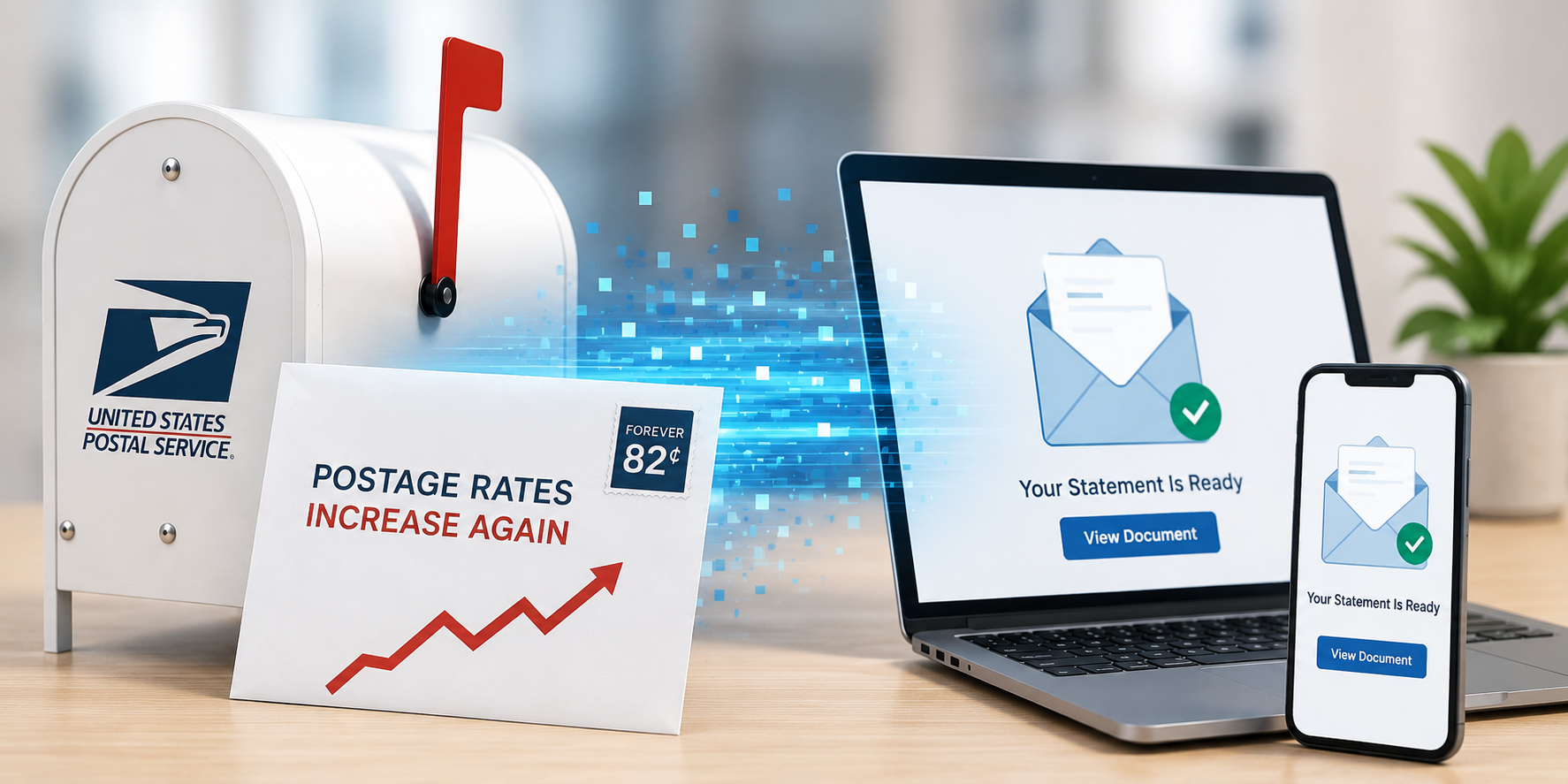
The U.S. Postal Service has once again increased mailing prices, with new rates taking effect on July 12, 2026.
The latest increase raises the price of a First-Class Forever Stamp from 78 cents to 82 cents, representing an average 4.8% increase across mailing services. While four cents may seem insignificant, organizations that mail thousands or even millions of billing statements, regulatory notices, and customer communications each year will feel the impact.
More importantly, this is not an isolated event. USPS has implemented multiple postage increases in recent years as it responds to declining mail volumes and rising operating costs. For organizations that rely heavily on physical mail, these increases reinforce the need to evaluate long-term customer communication strategies and accelerate digital adoption.
Editor's Note: This article was updated in July 2026 to reflect the latest USPS postage rate increases and current best practices for accelerating digital adoption.
In recent years, USPS has implemented several postage increases affecting both First-Class Mail and bulk mailing services. According to USPS, these price adjustments support its long-term financial sustainability while helping fund continued investments in infrastructure and operations. For businesses, the result is the same: rising costs for invoices, billing statements, regulatory notices, and other critical customer communications.
Here’s a breakdown of the recent changes:
First-Class Mail: Effective July 12, 2026, the price of a First-Class Forever Stamp increased from 78¢ to 82¢, representing an average 4.8% increase across mailing services.
Bulk Mailing: Organizations that rely on Marketing Mail and other bulk mail services will also see price increases, adding to annual mailing expenses for high-volume customer communications.
Special Services: Certified Mail, return receipts, and several other mailing services have also increased, further impacting organizations that depend on regulatory or time-sensitive correspondence.
For more information, visit theUSPS Postal Explorer website.
With postage rates continuing to rise, organizations are increasingly looking for ways to reduce their reliance on physical mail while continuing to support customers who prefer or require printed communications. .
.png?width=700&height=100&name=Banner%20-Technology%20Boosts%20Compliance%20in%20Consumer%20Finance%20Communications%20(11).png)
Why Digital Delivery is the Smart Choice for Businesses Today
Cost Savings: Increasing digital adoption reduces the number of communications that need to be printed and mailed. Over time, this can significantly lower print and postage spend while continuing to support customers who prefer physical mail. For organizations that send large volumes of customer communications, the savings can be substantial. According to a report by McKinsey, businesses can save up to 20-25% on operating costs through digital transformation.
Speed and Efficiency: Digital communications are instantaneous. Unlike traditional mail, which can take days to reach its destination, digital versions can be delivered and accessed in seconds. This speed can enhance your business’s efficiency, allowing for quicker responses and faster transactions. A study by McKinsey & Company found that digital transformation can increase efficiency by 20-30%.
Improved Customer Satisfaction: Today's customers increasingly expect the flexibility to receive and manage communications through their preferred channels. Digital delivery meets these expectations by providing customers with quick and easy access to their communications. Moreover, digital communications can be accessed from anywhere, at any time, adding an extra layer of convenience. When it comes to essential communications, almost two in three (61%) consumers would welcome digital versions of those documents currently required by law or regulation to be sent in paper format.
Environmental Benefits: Reducing paper usage is not only good for your budget but also for the environment. By cutting down on paper, ink, and transportation, your business can lower its carbon footprint, contributing to sustainability efforts. It is estimated by the Climate Group that digital applications could replace up to 25% of paper consumption.
Enhanced Security: Contrary to common belief, digital delivery can be more secure than traditional mail. Encrypted emails and secure online portals ensure that sensitive information is protected from unauthorized access. Additionally, digital records can be easily stored and retrieved, reducing the risk of lost or misplaced documents. According to IBM, digital documents with encryption can reduce the risk of data breaches by up to 70%.
Accommodating Customer Preferences
Despite the clear advantages of digital delivery, it's important to acknowledge that some customers still prefer receiving physical mail. Accommodating these preferences can enhance the overall customer experience. By offering both digital and print options, you can cater to a broader audience and maintain customer satisfaction. Clear communication about the benefits of each method and providing easy opt-in and opt-out processes will help ensure a smooth transition and higher customer acceptance.
Transitioning to Digital Delivery
Making the switch to digital delivery might seem daunting, but with the right approach, it can be seamless. Here are some steps to guide you through the process:
Evaluate Your Current Process: Assess how much you’re currently spending on physical mail and identify the documents that can be transitioned to digital formats.
Choose the Right CCM Provider: Select a reliable CCM partner that not only enables your business to send, clear, compliant, omnichannel customer communications, but also supports compliant omnichannel customer communications while helping you increase digital adoption at a pace that works for your organization.
Communicate with Your Customers: Inform your customers about the transition to digital delivery and highlight the benefits. Provide clear instructions on how they can access their communications online.
Why Partnering with the Right CCM Provider is Crucial
Shifting to digital communications involves more than just flipping a switch. It requires thoughtful integration of new processes, systems, and technologies. With postage costs skyrocketing, the urgency to switch is undeniable, but the process needs to be managed carefully.
Engaging a Customer Communication Management (CCM) provider can streamline this transition. These experts can help you evaluate your current setup, recommend the best tools, and guide you through the implementation phase. Whether you need a gradual shift or are ready for a more immediate change, a CCM partner can offer the flexibility and support you need.
How DataOceans Supports Digital Adoption
DataOceans stands out in the CCM field through its dedicated Client Success process, ensuring your journey to digital adoption is smooth and effective. Our team works closely with you to understand your unique needs, legacy systems, and business goals. We then craft a customized strategy to transition your customer correspondence to digital, step by step.
By partnering with DataOceans, organizations can deliver connected customer communications across print and digital channels while increasing digital adoption, improving customer engagement, and reducing print and postage spend over time.
With professional guidance from DataOceans, you can ensure that your shift to digital delivery is seamless, secure, and tailored to your specific needs, ultimately making your business more agile and responsive to future demands.
Embrace the change and make the smart choice for your business today!
For more information on how DataOceans can help you transition to digital delivery, contact us and start your journey towards a more efficient and cost-effective communication strategy!