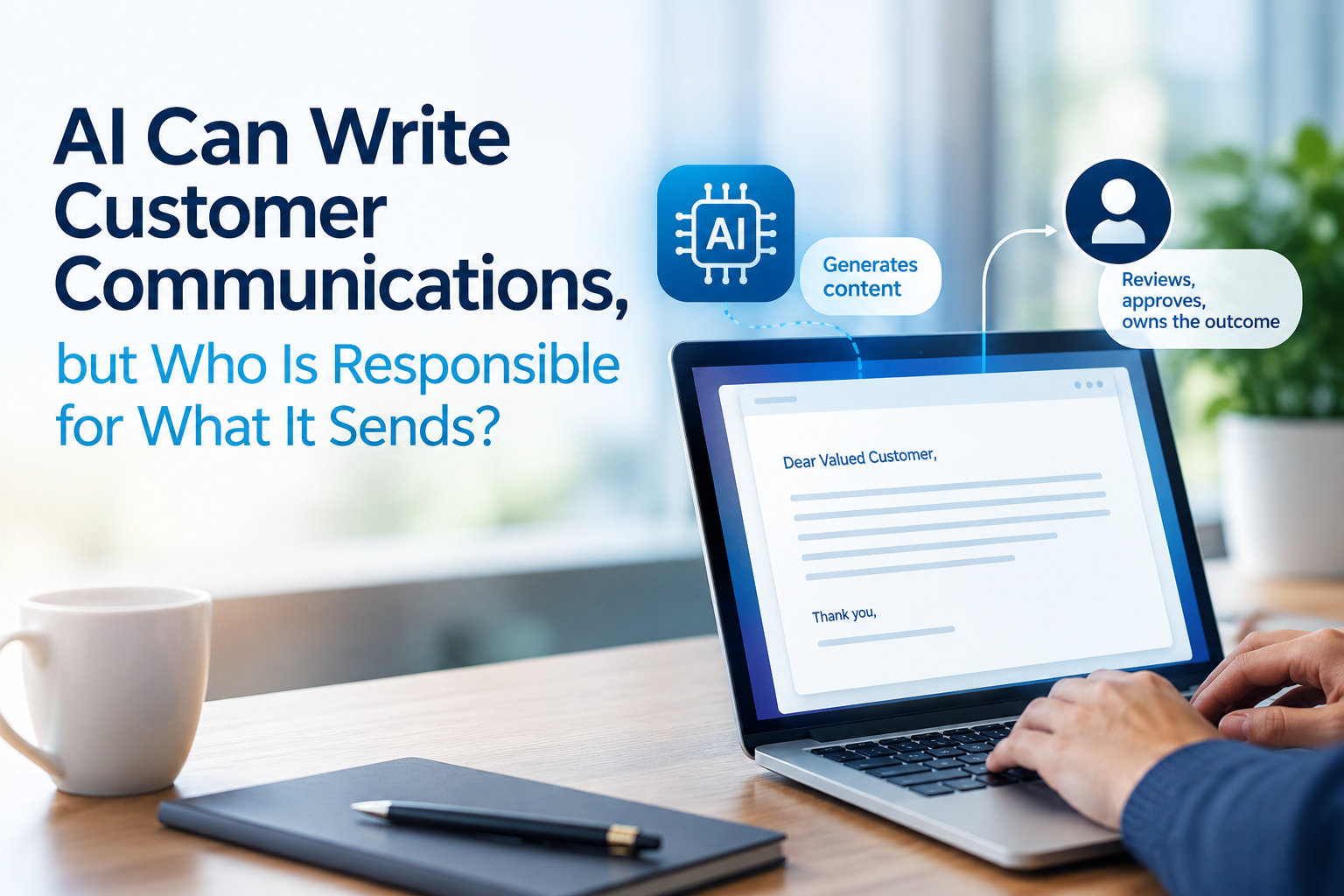
AI is becoming part of everyday work.
Employees use it to draft emails, summarize information, create presentations, and complete routine tasks faster. Employers are increasingly accepting, and in some cases, encouraging, its use.
But there is a difference between using AI to help someone do their job and using AI to create communications that go directly to customers.
That distinction matters.
For a regulated organization, the question isn't simply
Can AI create this communication?
It's:
Can we prove that the communication was accurate, approved, compliant, and delivered correctly?
AI changes how communications are created. It doesn't change who is accountable.
AI can help organizations produce content faster. It can personalize messages, adapt content for different channels, and reduce manual work.
But AI doesn't eliminate the need for oversight.
Consider a customer notice from a lender, an insurance communication, a healthcare statement, or a utility bill. These aren't just pieces of content. They can carry regulatory, financial, and operational consequences.
If something goes wrong, "the AI generated it" isn't an acceptable answer.
Organizations still need to know:
- What content was used and what was changed?
- Which version was approved and who approved it?
- Was the content compliant when it was sent?
- Which customers received it?
- Can the organization prove what was delivered?
Those questions become even more important as organizations introduce AI into their communication workflows.
Faster isn't necessarily better
One of AI's biggest promises is speed, and speed can be valuable.
But producing more communications faster doesn't help if organizations must spend more time reviewing, correcting, and tracking AI-generated output.
The goal shouldn't be more content.
It should be more accurate, more relevant, and more controlled communication with less manual effort.
That requires governance to be part of the process, not something added in after the communication has been created.
AI needs a governed communication layer
This is where DataOceans sees an important gap.
AI can generate content. But organizations need a trusted environment around that content — one that controls how communications are created, approved, updated, and delivered.
That's the role of a modern Customer Communications Management (CCM) platform.
DataOceans helps organizations bring governance into the communication lifecycle, so AI can be integrated into the workflow without introducing a new source of risk.
The model is straightforward:
Creates: AI can help draft, personalize, or transform content
Controls: Business rules and approved content determine what can be used
Approves: Authorized people review and approve communications before release
Governs: Version history, approvals, and compliance requirements remain visible
Delivers: The approved communication reaches the customer through the appropriate channel
Proves: Organizations can maintain an auditable record of what was approved and what was delivered
That last step is critical.
Because when a regulator, auditor, customer, or internal compliance team asks, "What exactly did you send?", an AI prompt or chat history isn't enough.
You need a record.
The real AI governance question
Much of the conversation around responsible AI focuses on the data going into AI systems or the models themselves.
Those issues matter.
But organizations also need to consider what happens after AI produces an answer or piece of content:
- Who controls it?
- Who reviews it?
- Who approves it?
- What happens when a regulation changes?
- What happens when an approved template is updated?
- What happens six months later when someone needs to prove exactly what a customer received?
Those are communication governance questions, and they become more important, not less, as AI becomes part of the process.
This is why DataOceans believes AI adoption and communication governance need to evolve together.
AI shouldn't sit outside the communication process. It should operate inside a controlled one.
The answer isn't to keep AI out of customer communications.
When used appropriately, AI can help organizations work faster and create more relevant customer experiences, but speed without control increases risk.
DataOceans provides governance, workflow, and auditability to help organizations use AI in customer communications in a controlled environment.
For organizations sending thousands or millions of communications, AI should be an additional capability within a governed communication process, not a replacement for it.
Because when customer communication matters, someone still needs to be accountable for what goes out the door.
FAQs
What does AI governance mean for customer communications?
AI governance for customer communications means putting controls in place for how AI-generated content is created, reviewed, approved, updated, and delivered. Organizations need to ensure communications are accurate, compliant, traceable, and consistent across channels.
Can AI-generated customer communications be compliant?
Yes, but AI-generated content should operate within an established review and approval process. Regulated organizations need controls to verify that communications meet current legal, regulatory and business requirements before they are delivered.
Why is communication governance important when using AI?
AI can accelerate content creation, but it does not eliminate accountability. Communication governance helps organizations control approved content, manage versions, document approvals, track changes, and maintain a record of what was delivered to customers.
How can organizations use AI without losing control of customer communications?
Organizations can use AI within a governed communication workflow. AI can assist with drafting, personalization, and content transformation while defined rules, human approval, version control, and audit trails provide oversight.
What should organizations track when AI is used to create customer communications?
Organizations should be able to track the content used, approved versions, changes, approvals, applicable compliance requirements, and the communications ultimately delivered to customers.
What is the role of Customer Communications Management (CCM) in AI governance?
CCM provides a controlled environment for managing customer communications across their lifecycle. It can help organizations govern content, approvals, versions, compliance requirements, and delivery across print and digital channels while incorporating AI into the workflow.
Can AI replace Customer Communications Management (CCM)?
No. AI and CCM serve different purposes. AI can help create or transform content, while CCM provides the processes and controls needed to manage, approve, deliver, and track customer communications at scale.
How does DataOceans help organizations govern AI-powered communications?
DataOceans provides a Customer Communications Management platform that helps organizations manage communication content, approvals, versions, governance, and delivery across channels. This allows organizations to incorporate AI into their communication processes while maintaining control and auditability.
Why is an audit trail important for AI-generated communications?
An audit trail helps an organization demonstrate what content was approved, who approved it, what changed, and what was ultimately delivered. This can be especially important for regulated communications where organizations may need to demonstrate compliance.
What types of organizations need AI customer communications to be governed?
Governed AI communications are particularly important for organizations that send high volumes of regulated or customer-critical communications, including banks, credit unions, lenders, insurers, healthcare organizations, and utilities.
What is the difference between AI content generation and AI communication governance?
AI content generation focuses on creating or modifying content. AI communication governance focuses on controlling what happens before and after that content is created—including review, approval, version control, compliance, delivery, and auditability. For regulated customer communications, both are important.