Health insurers continue to invest heavily in digital transformation.
Many have modernized core systems, introduced online payments, and expanded digital communications. Yet one area often remains surprisingly fragmented: the member's billing experience.
Members with multiple policies may still receive several bills. Payments may be processed separately. Customer service representatives often rely on complex billing systems that were never designed for fast, efficient member support.
These disconnected experiences create unnecessary work for employees while making billing more difficult for members.
The good news is that improving the billing journey does not always require replacing existing billing systems. It often begins by connecting the experiences that already surround them.
The Hidden Cost of Fragmented Billing
For many health insurers, billing has evolved over many years.
- Different products
- Different billing systems
- Different payment processes
- Different communication workflows
Each system may work independently, but together they create a fragmented experience.
Members may need to:
- Review multiple billing statements
- Make separate payments
- Track different due dates
- Contact customer service to answer routine billing questions
At the same time, contact center teams spend valuable time navigating complex back-end systems simply to complete everyday service requests.
The result is higher operating costs, longer call times, and lower member satisfaction.
Modernization Should Simplify the Member Experience, Not More Complex
Many digital transformation projects focus on replacing technology rather than simplifying the member experience. Before updating your customer communications management system, you should ask yourself the following questions:
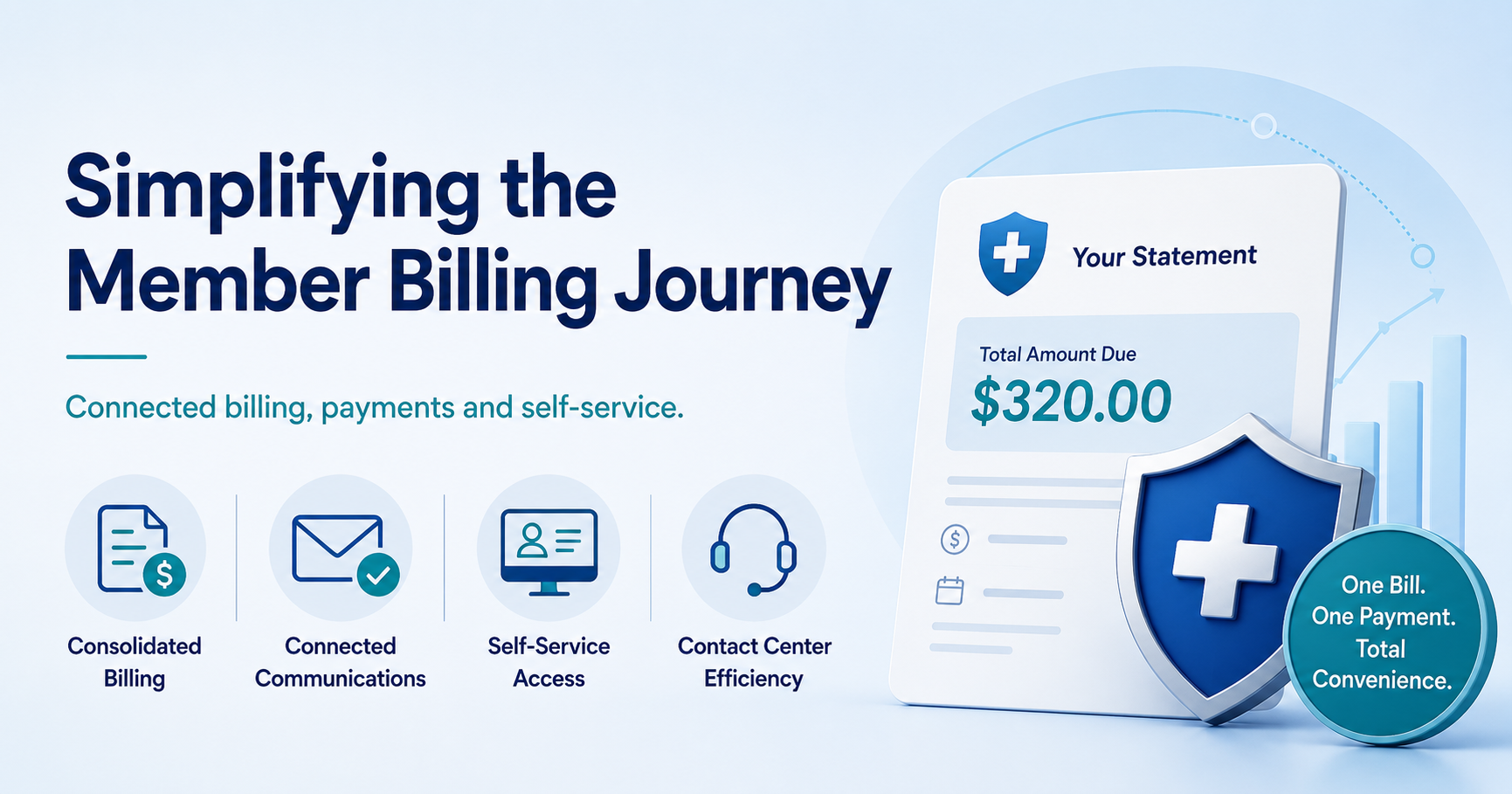
- Can members receive one bill instead of several?
- Can multiple payments become one transaction?
- Can billing communications work together?
- Can members solve common billing questions themselves?
- Can customer service teams work from a simpler interface?
These improvements reduce complexity without requiring organizations to replace the systems that already manage policies and billing.
DataOceans recently won the Global Innovation Challenge for solving one of the most costly problems in health insurance: disconnected billing, payments, and member communications.
🎬 To bring it to life, we made a short, Office-style mockumentary: “The Data Drama.”
Watch our award-winning video now!
One Health Insurer Took a Different Approach
A leading U.S. health insurer serving millions of members faced many of these same challenges.
Members with medical, dental, and vision coverage often received multiple billing statements and completed separate payment transactions.
Customer service representatives relied on a complex billing platform that increased handling times for routine member requests.
Rather than replacing core billing systems, the organization adopted a phased modernization strategy.
Phase 1: Modernize Billing Statements
The first step focused on improving billing communications.
New statement designs made bills easier to understand while encouraging digital engagement.
Automated integration with the existing billing platform established a foundation for future improvements.
Phase 2: Consolidate Billing
Set up business rules that automatically identify members with multiple eligible policies and consolidate their billing into one easy-to-read statement. This reduced billing confusion and diverted calls from busy centers.
Phase 3: Simplify Payments
Payments were automatically reconciled and allocated back to each policy. Members experienced a simpler payment process while the organization reduced transaction costs.
Phase 4: Connect Billing Communications
The organization expanded communications across the billing journey, including:
- Billing statement notifications
- Payment confirmations
- Payment failure notifications
- Billing-related member correspondence
Rather than treating each communication as a separate interaction, they became part of one connected member experience.
Self-Service Became the Next Logical Step
Once billing and payment communications were modernized, the organization expanded digital self-service.
Members could:
- View billing statements
- Access statement history
- Review payment history
- Make payments online
- Complete common billing activities without calling customer service
Instead of replacing customer service, self-service gives members another convenient way to manage their accounts.
For many routine requests, that meant fewer inbound calls and faster resolutions.
Better Tools for Customer Service Representatives
The final phase focused on improving employee efficiency.
Instead of requiring representatives to navigate a complex billing platform, the organization developed a simplified CSR interface focused on the tasks that agents performed most often. The result was a more efficient workflow that reduced the time required to resolve member inquiries.
The Overall Results
What began as a focus on the tasks evolved into a broader digital transformation spanning billing, payments, customer communications, self-service, and contact center operations.
The organization achieved measurable business outcomes, including:
- 75% reduction in contact center call handle times
- Lower payment processing costs
- Reduced print and mail volumes
- Simpler billing for members with multiple policies
- More consistent billing communications
- Greater member self-service adoption
- Improved agent productivity
Perhaps most importantly, these improvements were delivered without replacing the organization's existing billing environment.
Modernization Is About Connecting Experiences
Many healthcare organizations already have the systems they need to manage billing.
The opportunity lies in connecting the experiences that surround those systems.
When billing, payments, customer communications, self-service, and customer service operate together, organizations reduce operational complexity while making life easier for members.
That creates benefits across the business, from lower operating costs to better member experiences and more efficient service operations.
Digital transformation does not always begin with replacing technology.
Sometimes it begins by making every interaction work better together.
How DataOceans Supports Health Insurers
DataOceans helps health insurers modernize the entire member billing journey by connecting member communications, billing and payment enablement, digital self-service, and contact center workflows within a unified platform.
Rather than requiring organizations to replace existing core systems, DataOceans helps them build a more connected, efficient member experience around those systems.
Ready to simplify your member billing experience?