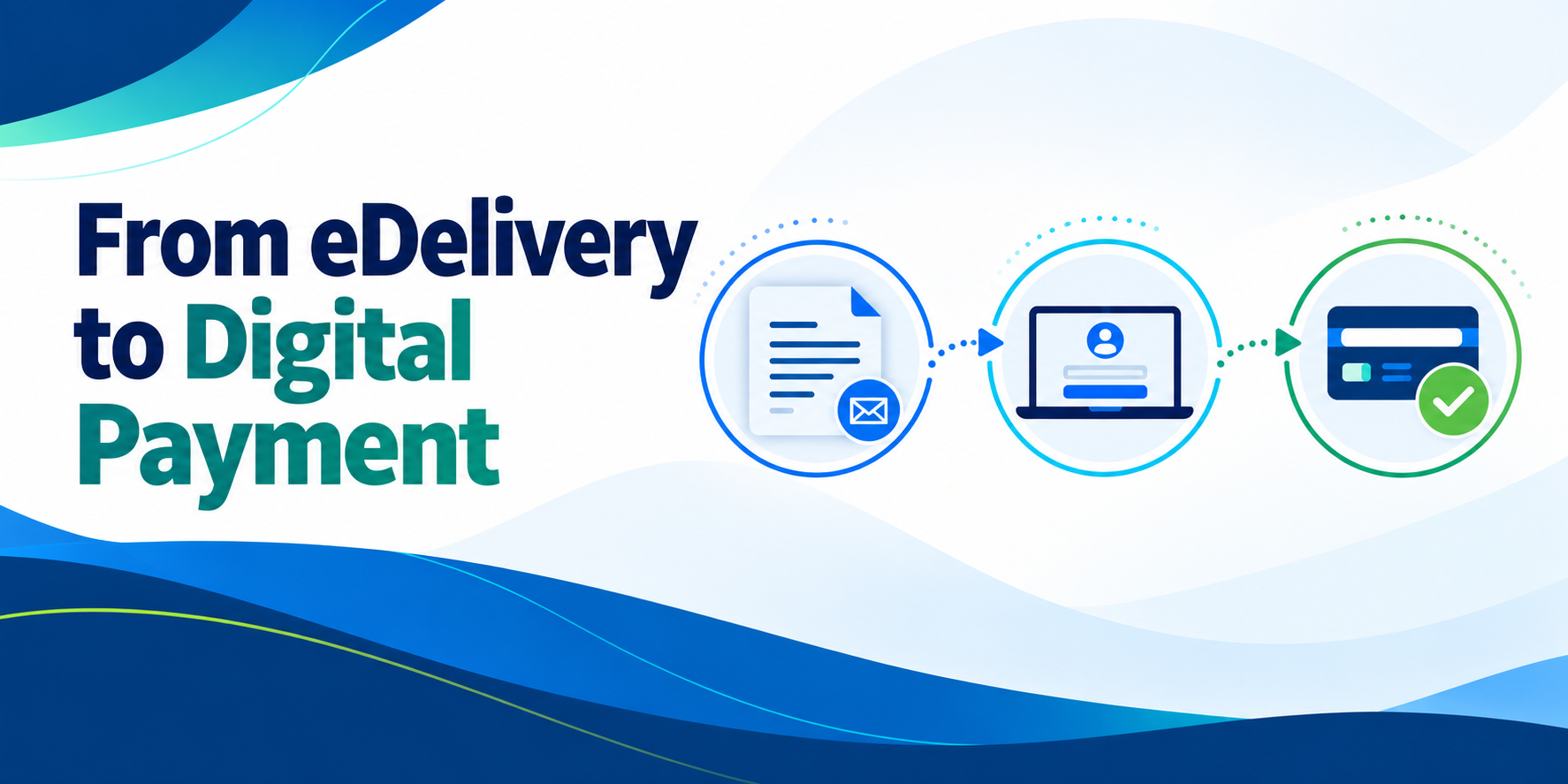
Eight years of billing data from one national home healthcare provider show a clear pattern: as eDelivery increased, digital payment adoption rose with it. More statements were delivered electronically, and more patients paid online by card.
The relationship is difficult to ignore.
The key takeaway is straightforward: the payment journey begins before the payment screen. How customers receive and understand their bills can influence what they do next.
The Payment Journey Begins with the Billing Statement
Customers cannot act on information they have not received or cannot easily access.
Before making a payment, a customer must usually:
- Receive the statement
- Understand the amount due
- Review the relevant account information
- Find an available payment option
- Complete the payment securely
A printed statement separates out these steps. The customer receives a physical document and must then move to another channel, such as a website, phone system, or mailed payment.
eDelivery can shorten that process by connecting statements via secure self-service, allowing customers to quickly review their account information and proceed directly to payment.
This makes the customer statement delivery part of the payment experience rather than a separate administrative step.
Higher eDelivery Coincided with More Digital Card Payments
In January 2018, approximately 7% of the healthcare provider’s customers received statements electronically.
By May 2026:
- The eDelivery rate had increased to more than 33%.
- Monthly electronic statement volume exceeded 115,000.
The provider now delivers more than 82,000 additional electronic statements each month.
During the program, electronic statement volume and digital card payments showed a strong correlation.
Payment behavior can also be affected by available payment methods, account balances, customer preferences, and the quality of the self-service experience.
The pattern supports a connected approach to billing communications, account access, and payments.
How does eDelivery adoption Support Digital Payment adoption?
Several practical factors may explain the link:
- Faster Access to Billing Information
- A More Direct Next Step
- Clearer Customer Guidance
- Convenient Self-Service
Electronic delivery removes the time required to print, process, and mail a statement. Customers can review information sooner from a phone, tablet, or computer and act earlier.
Electronic communication can guide customers directly to secure self-service. A clear link or authenticated digital route can reduce the steps between receiving a statement and making a payment.
Customers are more likely to complete an action when the instructions are easy to understand. Consistent emails, QR codes, portal messages, and statements can explain where to access account information and how to proceed. This reduces uncertainty within the payment journey.
Customers increasingly expect to manage routine account tasks on their own schedule. A reliable portal can give them a single place to view statements, review details, and reach payment options.
How Did the Healthcare Provider Strengthen the Paperless Journey?
The healthcare provider did not rely on a single paperless campaign. It made a series of focused changes to the customer experience.
Working with DataOceans, the provider:
- Simplified eDelivery enrollment
- Improved email instructions
- Contacted customers with unverified email addresses
- Added QR codes for more direct statement access
- Removed an enrollment step that was limiting completion
- Used targeted messaging to promote electronic delivery
- Strengthened authentication
- Moved customers to an updated self-service portal
These changes addressed the route from communication to account action.
Together, these changes made enrollment easier, improved access, and created a clearer path into self-service.
What Is the Business Value of a Connected Bill-to-Payment Journey?
A connected billing-to-payment experience can create value across several areas.
Lower Print and Postage Requirements
Each electronic statement eliminates one communication step from the print-and-mail process. As eDelivery volume increases, fewer statements require paper, physical production, and postage.
Greater Use of Digital Channels
Electronic statements bring more customers into digital channels where they can complete routine account tasks.
An Easier Customer Experience
Customers should not have to determine which system holds their statement, where to find their balance, or how to reach a payment option. A connected experience provides a clearer route from receiving information to acting on it.
Better Insight into Customer Behavior
Digital interactions provide measurable information about enrollment, statement access, and payment activity. Organizations can use this data to identify where customers stop, which communications prompt action, and where the journey needs further attention.
How Should Organizations Measure the Relationship Between eDelivery and Digital Payments?
eDelivery and digital payment results should be reviewed together because each measure shows only part of the customer journey.
Useful measures include:
- eDelivery adoption rate: The percentage of eligible customers receiving statements electronically.
- Electronic statement volume: The number of statements delivered through digital channels each month.
- Digital payment activity: The volume and percentage of payments completed through digital options.
- Enrollment completion: The percentage of customers who finish the eDelivery enrollment process.
- Statement access: Whether customers successfully reach and view their electronic statements.
- Print and mail volume: The number of statements that still require physical production and postage.
- Customer abandonment: The points where customers leave the enrollment, authentication, statement access, or payment process.
Reviewing these measures over time can reveal whether changes to customer communications are supporting wider digital behavior.
Look Beyond the Payment Receipt
Organizations seeking more digital payments should examine the steps that occur before payment. The experience depends on clear information, easy access to accounts, and a convenient way to act.
The healthcare provider’s results show that eDelivery and digital card payments rose together as the broader billing experience improved.
DataOceans helps regulated organizations connect customer data, statement communications, delivery preferences, digital self-service, and integrated payment options.
Is your billing experience limiting digital payment adoption?
DataOceans can help you connect eDelivery, statement access, digital self-service, and integrated payment options across the billing-to-payment journey.
Review Your Billing-to-Payment Journey – Schedule a call:

Frequently Asked Questions
Does eDelivery increase digital payments?
eDelivery can support digital payment adoption by giving customers faster access to account information and a more direct route to self-service.
Is there evidence that eDelivery leads to more payments?
The data shows a strong correlation between electronic statement volume and digital card payments. Other factors may also affect payment behavior, including payment choices, customer preferences, and the self-service experience.
How does eDelivery improve the payment journey?
eDelivery allows customers to receive statements sooner, access account information digitally, and proceed more easily to an available payment option.
What is a connected billing-to-payment journey?
A connected billing-to-payment journey brings statement delivery, account access, self-service, and payment options together so customers have a clear route from bill receipt to action.
Which metrics should organizations track?
Organizations should monitor eDelivery adoption, electronic statement volume, enrollment completion, statement access, digital payment activity, print volume, and customer abandonment points.