A 2025 Sinch survey of 2,800 consumers and more than 400 financial services leaders confirms that the gap between customer expectations and institutional communication delivery continues to widen. Fraud alerts arrive late. Statements confuse rather than clarify. Regulatory notices land in the wrong channel at the wrong time.
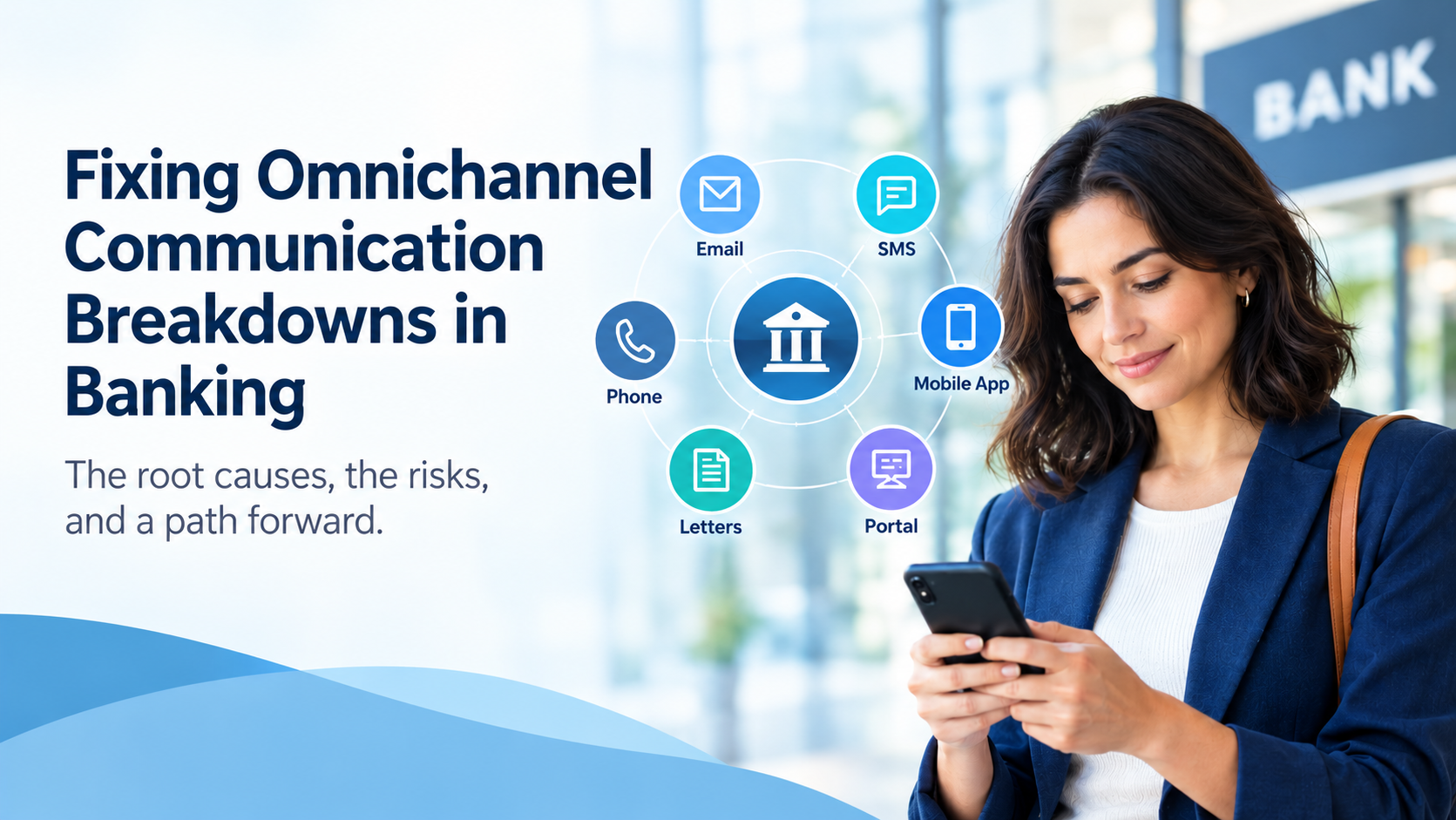
These are not isolated incidents. They are symptoms of a structural problem that affects how financial institutions manage customer communications management across compliance, data, channel, and governance workflows. This guide maps the root causes of omnichannel communication breakdowns in banks and credit unions, then provides a practical framework for fixing them.
Key Takeaways:
Customer Communication Breakdowns in Banking
- Fragmented data systems force banking teams to operate with incomplete customer views, creating inconsistent messaging across channels.
- Compliance risk escalates when communication workflows lack centralized governance, audit trails, and version control for regulated notices.
- Channel silos prevent banks from honoring customer delivery preferences, leading to frustration and eroded trust over time.
- DataOceans connects data, communications, and governance into a single platform that helps financial institutions coordinate omnichannel delivery.
- Institutions that centralize communication governance see measurable improvements in payment behavior, call center volume, and regulatory readiness.
Why Customer Communication Breakdowns Happen in Financial Institutions
Communication breakdowns in banking rarely stem from a single failure. They emerge from the accumulated effect of disconnected systems, competing priorities, and operational structures built for a different era.
A Genesys 2025 report found that 53% of consumers globally had to repeat information to a second agent during an interaction in the past year. In financial services, where every communication is also a compliance event, that fragmentation carries measurable regulatory and financial consequences.
Understanding where these breakdowns originate is the first step toward building a defensible communication infrastructure. The root causes fall into four categories: compliance complexity, data fragmentation, channel silos, and governance gaps.
How Compliance Complexity Creates Communication Failures
Regulatory obligations in banking and credit union environments are not static. CFPB requirements, state attorney general enforcement actions, and evolving disclosure mandates create a constantly shifting landscape.
Every account statement, adverse action notice, and payment reminder must meet specific content, timing, and delivery requirements. When those requirements change, institutions relying on manual processes or fragmented template libraries struggle to update communications across all channels before deadlines arrive.
The consequence is measurable. The SEC issued more than $600 million in fines tied to messaging violations in 2024, according to industry reporting. Many of those penalties targeted something as fundamental as using the wrong channels for client communications.
For banks and credit unions, the risk extends to every notice, disclosure, and statement that leaves the institution without centralized compliance controls.
The operational challenge is clear. When compliance teams cannot update a disclosure across print, email, SMS, and portal channels from a single template, the institution operates with multiple versions of the same communication in production simultaneously. That creates audit exposure and increases the likelihood of regulatory findings.
What Compliance-Ready Communication Infrastructure Looks Like
A compliance-ready communication environment embeds regulatory rules directly into communication workflows. Template changes propagate across all channels from a single source of truth. Approval workflows capture every edit, every reviewer, and every sign-off. Audit trails document what was sent, when, to whom, and through which channel.
DataOceans Compliance Hub+ powered by Hudson Cook embeds attorney-backed, legally maintained templates directly into communication workflows. This approach reduces the lag between regulation changes and implementation, lowering exposure to compliance gaps while maintaining operational readiness.
How Data Fragmentation Undermines Omnichannel Messaging
Most established banks and credit unions operate on core systems built for transaction processing, not communication orchestration. Customer data sits in legacy CRMs, loan servicing platforms, document archives, and core banking systems that were never designed to share information in real time.
The downstream effect is structural inconsistency. A customer receives one version of their account information through their online portal and a different version in a mailed statement because the two systems pulled data at different times from different sources.
This is not a minor inconvenience for the customer. It is a trust problem. A Deloitte study found that 70% of consumers consider a consistent multi-channel experience extremely or very important when selecting a primary bank.
When data fragmentation makes that consistency impossible, the institution loses competitive ground to organizations that have solved the data unification problem.
The cost extends beyond customer attrition. Duplicate processes, redundant infrastructure, and inconsistent data management across siloed systems consume IT budgets that would otherwise fund modernization. Institutions get locked into a cycle where maintaining legacy environments absorbs the resources needed to replace them.
What a Connected Data Foundation Requires
Solving data fragmentation does not require replacing core banking systems. It requires a data enablement layer that connects existing systems and creates a unified customer view for communication purposes.
That layer must pull from loan servicing platforms, payment systems, CRM tools, and core banking applications to assemble accurate, current customer data at the moment each communication is generated.
DataOceans provides this data enablement layer through the Oceanus CCM platform, which connects to existing core systems to unlock and unify customer data without requiring institutions to replace their current infrastructure. The result is a single, actionable customer view that drives accurate, personalized communications across every channel.
How Channel Silos Prevent Consistent Customer Experiences
Banking customers interact with their institutions through mobile apps, online portals, email, SMS, print statements, and call centers. Each channel typically operates on its own technology stack, managed by a different team, with its own content creation and approval process.
The result is predictable. A customer receives a payment reminder via email that contradicts what their mobile app displays. A regulatory notice arrives by mail days after the same information appeared in their portal.
The Talkdesk 2024 CX in Banking Survey found that eight in ten respondents cited "disjointed experiences across touchpoints" as a leading cause of customer frustration. That frustration translates directly into increased call center volume, longer resolution times, and higher operational costs.
Channel silos also prevent institutions from honoring customer delivery preferences. When a customer opts for digital-only communications but continues to receive printed statements because the preference data does not flow to the print production system, the institution has failed a basic expectation.
KPMG's 2025 Banking Survey found that 95% of institutions are actively investing in mobile experience improvements. Yet many still cannot coordinate messaging across the channels those mobile users also rely on.
What Coordinated Channel Delivery Looks Like in Practice
Coordinated omnichannel delivery requires a central rules engine that determines which communications go to which channels and when, based on customer preferences and regulatory requirements. Templates and content blocks must be reusable across channels so the same message renders appropriately in any format.
DataOceans Customer Portal connects customer communications, billing, and payments into a single self-service experience. When paired with the platform's Letter Manager and Statement Manager, institutions deliver consistent messaging across print, email, SMS, and digital channels from a single communication design.
How Governance Gaps Turn Operational Risks into Regulatory Exposure
Communication governance in banking encompasses more than compliance review. It includes content approval workflows, version control, template management, delivery tracking, and audit documentation. When any of these governance elements operates outside a centralized system, the institution creates blind spots that accumulate into material risk.
Consider a common scenario. A product team updates the language on a payment reminder email to improve clarity. That update does not flow to the printed version, the SMS variant, or the portal display.
Three weeks later, a compliance audit identifies the discrepancy. The institution must document when the inconsistency began, how many customers received conflicting information, and what remediation steps are required. Without centralized governance, answering those questions consumes significant time and resources.
The GreySpark Partners 2025 report on financial compliance found that many financial institutions still struggle with fragmented digital communications data, incomplete surveillance coverage, and inefficient archiving, even after years of investment. Regulatory pressure continues to mount, with global authorities issuing heavy fines for inadequate communications oversight.
What Effective Communication Governance Requires
Effective governance centralizes five capabilities: content management, approval workflows, delivery orchestration, version control, and audit documentation. Every change to a customer-facing communication must flow through an approval process that captures who made the change, who reviewed it, and when it was approved.
DataOceans structures communication governance around five pillars: content, approval, workflow, delivery, and audit governance. This framework gives compliance, operations, and business teams a shared infrastructure for managing regulated communications without creating bottlenecks or dependencies on IT for routine updates.
A Framework for Fixing Omnichannel Communication Breakdowns
Addressing communication breakdowns requires a structured approach that tackles the root causes identified above. The following framework organizes the remediation path into three interconnected capabilities: connected data, coordinated communications, and embedded governance. These three elements form the operational foundation for reliable omnichannel execution in regulated financial environments.
Step 1: Connect Your Customer Data
Start by creating a unified data layer that aggregates customer information from core banking systems, loan servicing platforms, payment processors, and CRM tools. This layer must operate in real time or near-real time so that communications reflect the most current account status and regulatory standing.
Key actions include mapping all data sources that feed customer communications and identifying where discrepancies originate. Implement a data enablement layer that normalizes information across systems. This step does not require replacing existing infrastructure. It requires connecting it.
Step 2: Coordinate Communications Across Channels
Once data flows from a unified source, the next step is ensuring that communications generated from that data render consistently across every channel. This means creating reusable templates that adapt to print, email, SMS, and portal formats while maintaining message integrity. It also means implementing a preference management system that captures and honors each customer's channel choices.
Institutions should implement a central rules engine that routes communications based on customer preferences, regulatory requirements, and message type. Payment reminders may require SMS delivery within a specific window. Regulatory disclosures may require both digital and physical delivery. The rules engine must handle these variations without manual intervention for each communication.
Step 3: Embed Governance Into Every Communication Workflow
Governance cannot be an afterthought or a quarterly audit exercise. It must be embedded into the communication workflow itself. Every template change triggers an approval process. Every delivery generates an audit record. Every version of every communication is archived with metadata that identifies what changed, when, and by whom.
This level of governance reduces regulatory exposure by ensuring that compliance teams can answer auditor questions with documented evidence rather than manual reconstruction. It also reduces operational cost by eliminating the rework and remediation that follow governance failures.
How to Assess Your Institution's Communication Maturity
Before implementing changes, it is valuable to understand where your institution currently stands. The following assessment framework helps banking and credit union leaders evaluate their communication infrastructure across the four dimensions covered in this guide.
Data Connectivity Assessment
Evaluate how many systems feed customer communications. Determine whether those systems share data in real time or through batch processes. Identify the most common data discrepancies that appear in customer-facing communications. Institutions with three or more disconnected data sources feeding communications are operating at elevated risk for inconsistency.
Channel Coordination Assessment
Map every channel through which your institution communicates with customers. Determine whether each channel operates on its own template library or shares templates with other channels. Identify whether customer preferences are captured, stored, and honored across all channels. Institutions that cannot trace a single communication across all delivery channels have a coordination gap.
Compliance Readiness Assessment
Review how quickly your institution can implement a regulatory change across all communication channels. Measure the time between a compliance requirement change and full implementation across print, email, SMS, and portal channels. Institutions that require more than five business days to propagate a compliance change across all channels face elevated audit risk.
Governance Maturity Assessment
Determine whether your institution maintains centralized version control for all customer-facing communications. Evaluate whether approval workflows are documented and enforceable. Assess whether audit trails capture sufficient detail to reconstruct any communication sent to any customer at any point in time. Institutions without centralized governance documentation are operating with material compliance exposure.
The Measurable Impact of Fixing Communication Breakdowns
Financial institutions that address communication breakdowns through connected data, coordinated channels, and embedded governance see measurable operational improvements. These outcomes are not theoretical. They reflect the operational realities that institutions experience when communication infrastructure moves from fragmented to unified.
Institutions that deploy centralized customer communications management platforms typically see a 7% to 15% reduction in contact center activity because clearer, more consistent communications reduce the volume of customer inquiries driven by confusion or conflicting information.
Payment behavior improves as well. Institutions report a 5 to 10+ business day improvement in Days Sales Outstanding (DSO) when billing statements and payment reminders are coordinated across channels and delivered through customers' preferred methods. Autopay enrollment increases of 15% to 35% follow when digital communications include clear, actionable enrollment paths.
Regulatory readiness improves because centralized governance creates auditable records of every communication, every change, and every approval. When an examiner asks what a specific customer received and when, the answer is available in seconds rather than days of manual reconstruction.
Common Mistakes Banks Make When Addressing Communication Breakdowns
Addressing communication challenges is not simply a technology procurement exercise. Institutions that approach it that way often make predictable mistakes that undermine their investment.
Treating Communication as a Marketing Function
Customer communications in banking are operational infrastructure, not marketing collateral. Statements, regulatory notices, payment reminders, and adverse action letters carry compliance obligations and financial consequences.
When institutions assign communication ownership to marketing teams without operational and compliance input, the resulting communications often prioritize design over accuracy and engagement over regulatory rigor.
Implementing Channel-Specific Solutions
Adding a new email platform, a separate SMS tool, and a standalone portal without connecting them to a unified data and governance layer creates additional silos. Each new tool introduces its own template library, its own approval process, and its own data integration. Governance gaps multiply rather than close.
Delaying Governance Until After Technology Deployment
Institutions that deploy a communication platform without establishing governance protocols first often discover that governance gaps were not addressed by the technology itself. A platform can support governance, but it cannot create governance culture. Content approval workflows, version control policies, and audit documentation standards must be defined before the platform is configured, not after.
How DataOceans Helps Financial Institutions Fix Communication Breakdowns
DataOceans is the only customer communications platform orchestrating modern customer experiences that drive on-time payments. The platform addresses each of the four breakdown categories covered in this guide through an integrated approach that connects data, coordinates communications, and embeds governance into every workflow.
For banks and credit unions specifically, DataOceans connects to existing core banking and loan servicing systems to create a unified customer view without requiring infrastructure replacement. Communications are designed once and delivered consistently across print, email, SMS, and digital portal channels.
Governance controls ensure that every template change, every approval, and every delivery is documented and auditable.
The platform's data enablement layer unlocks customer data from existing systems, supporting personalized communications that reflect current account status, payment history, and channel preferences. This connected approach reduces the operational cost, compliance risk, and customer friction that result from fragmented communication infrastructure.
How to Build a Defensible Communication Infrastructure
Communication breakdowns in financial institutions are not inevitable. They are the predictable result of disconnected data, siloed channels, fragmented governance, and compliance processes that were not designed for omnichannel execution.
The institutions that address these causes systematically position themselves for measurable improvements in regulatory readiness, operational efficiency, and customer trust.
The window to build a defensible governance infrastructure is now. Regulatory scrutiny is intensifying. Customer expectations are rising. The operational cost of maintaining fragmented communication systems compounds with every quarter that passes without action.
A structured approach to fixing these breakdowns does not just reduce risk. It creates the operational foundation for sustained performance improvement.
FAQs About Customer Communication Breakdowns in Banking
What role does compliance play in customer communication management?
Compliance is embedded in every customer communication a bank sends. Regulatory disclosures, adverse action notices, and billing statements carry specific content, timing, and delivery requirements. DataOceans Compliance Hub+ powered by Hudson Cook integrates attorney-backed templates directly into communication workflows to reduce compliance gaps.
How does data fragmentation affect banking communications?
Data fragmentation forces banks to generate communications from incomplete or conflicting customer information. When loan servicing, core banking, and CRM systems do not share data in real time, customers receive inconsistent account details across channels. DataOceans solves this by connecting existing systems through a data enablement layer that creates a unified customer view.
What is communication governance in financial services?
Communication governance encompasses content management, approval workflows, version control, delivery tracking, and audit documentation for every customer-facing communication. In regulated financial environments, governance ensures that compliance teams can document exactly what each customer received, when, and through which channel.
How does fixing communication breakdowns affect payment behavior?
Institutions that coordinate billing statements and payment reminders across channels typically see a 5 to 10+ business day improvement in Days Sales Outstanding. Clearer communications reduce confusion, and digital delivery through preferred channels increases the likelihood of timely payment. DataOceans customers often report autopay enrollment increases of 15% to 35%.
What is the first step to fixing communication breakdowns in banking?
The first step is assessing your current communication infrastructure across four dimensions: data connectivity, channel coordination, compliance readiness, and governance maturity. This assessment identifies the specific root causes affecting your institution and prioritizes remediation based on risk and operational impact.