Selecting a customer communications management (CCM) platform is no longer just an IT decision.
For banks and credit unions, customer communications directly impact compliance, member experience, digital adoption, and operational efficiency. Statements, regulatory notices, payment reminders, and other communications are often the most frequent interactions clients and members have with their financial institution.
As regulatory requirements evolve and member expectations continue to rise, financial institutions need more than a document generation tool. They need a communications platform that helps them deliver clear, compliant, and actionable communications across every channel.
What Should Banks and Credit Unions Look for in a CCM Platform?
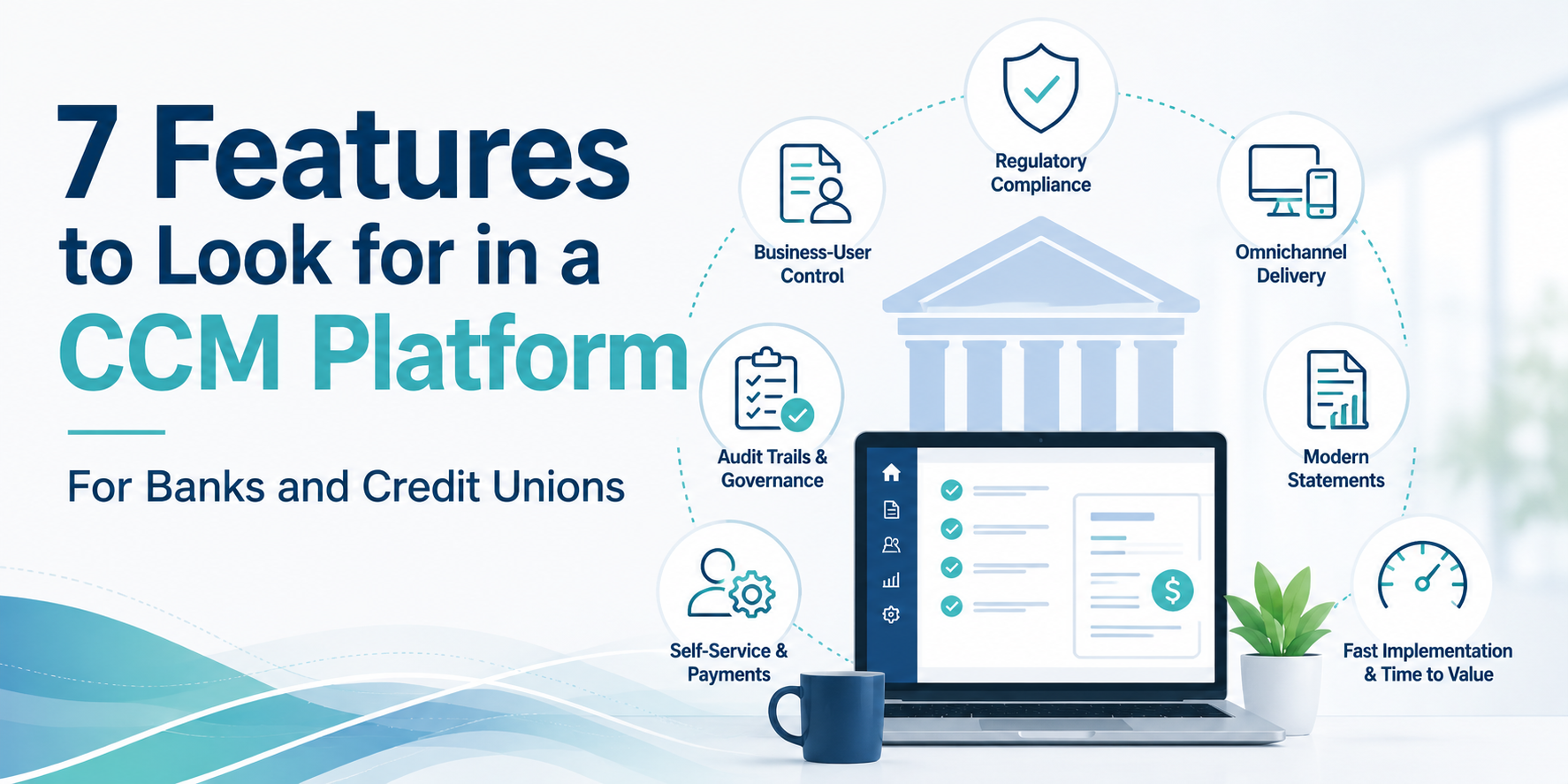
When evaluating a CCM platform, look for solutions that provide:
- Business-user content control
- Regulatory communication management
- Audit trails and governance
- Omnichannel delivery
- Modern statement design capabilities
- Self-service and payment integration
- Fast implementation and time to value
- Scalability for future growth
Let's now explore each feature in more detail.
1. Can Business Users Make Changes Without IT?
Many financial institutions still rely on IT resources to make routine communication updates.
Whether it's updating a regulatory disclosure, revising a payment reminder, or changing statement messaging, these requests often compete with larger technology priorities.
A modern CCM platform should empower compliance, operations, and marketing teams to make approved content changes without lengthy development cycles.
The solution should provide:
- Self-service content management
- Role-based permissions
- Approval workflows
- Version control
Reducing IT dependency can help organizations respond faster to business and regulatory changes.
2. Does the Platform Support Regulatory Customer Communications?
For many financial institutions, regulatory communications represent some of the highest-risk customer touchpoints, making governance and consistency essential. Regulatory communications require a higher level of governance than traditional customer messaging.
From adverse action notices and servicing letters to state-specific disclosures, financial institutions must ensure communications remain accurate, consistent, and compliant to avoid heavy penalties.
The platform should support:
- Approval workflows
- Template management
- Jurisdiction-specific communications
- Regulatory change management
- Content governance controls
A CCM platform with strong governance controls can help reduce risk while simplifying communication management.
3. Does the Platform Provide Audit Trails and Version Control?
Examiners and internal audit teams often need visibility into communication history.
Organizations should be able to answer questions such as:
- Who approved the communication?
- When was it updated?
- Which version was delivered?
- Which customers received it?
Strong audit trails and version control help create operational transparency while reducing compliance risk.
The solution should provide:
- Automated audit logs
- Approval history
- Communication archives
- Change tracking
4. Can Communications Be Delivered Across Print and Digital Channels?
Member preferences continue to evolve.
Some customers still prefer paper communications, while others expect email, text messaging, or digital access through a customer portal.
A CCM platform should support a consistent experience across:
- Automated audit logs
- Approval history
- Communication archives
- Change tracking
- SMS/RCS
- Customer portals
- Electronic document delivery
The goal is to reach customers through their preferred channel while maintaining message consistency.
5. Does the Platform Help Improve Statement Effectiveness?
Statements remain one of the most valuable communication assets available to financial institutions. It is your monthly billboard, delivered directly to your customer.
Yet many statements are still designed primarily for compliance rather than customer engagement.
Modern CCM platforms should help organizations create statements that are easier to understand and easier to act upon.
Look for capabilities such as:
- Improved readability
- Personalized messaging
- Dynamic content
- QR codes
- Payment links
- Targeted educational content
Clearer statements can improve engagement while diverting calls from busy service centers. They can also support payment performance by helping customers better understand what they owe, when payment is due, and how to take action.
6. Does the CCM Platform Connect Communications to Self-Service?
The most effective communications do more than deliver information. They help customers take action.
When communications connect directly to self-service experiences, financial institutions can improve convenience while reducing operational workload.
Look for platforms that support:
- Customer portals
- Online document access
- Preference management
- Self-service account activities
- Integrated payment experiences
The easier it is for customers to complete tasks on their own, the more value organizations can realize from their communications strategy. Self-service experiences can also help reduce call volume while increasing digital engagement.
7. How Quickly Can the Platform Deliver Value?
Lengthy implementation projects can delay business outcomes and increase project risk.
Financial institutions should evaluate not only platform functionality, but also implementation methodology and support.
Consider:
- Deployment timelines
- Training requirements
- Industry expertise
- Ongoing support services
- Scalability
A faster path to value allows organizations to modernize communications sooner, with fewer IT resources leading to measurable results.
CCM Evaluation Checklist for Banks and Credit Unions
Use this checklist when evaluating potential CCM providers:
✓ Business-user content management
✓ Regulatory communication workflows
✓ Audit trails and version control
✓ Multichannel delivery capabilities
✓ Statement modernization tools
✓ Customer portal integration
✓ Self-service support
✓ Implementation expertise
✓ Scalability and future growth support
The Best CCM Platforms Do More Than Generate Documents.
They help banks and credit unions deliver clear, compliant, and actionable communications that improve member experiences, support regulatory requirements, and encourage digital engagement.
As customer expectations continue to evolve, financial institutions should look for platforms that connect communications, self-service, and customer action into a more seamless experience.
Not Sure if Your Current CCM Platform Measures Up?
Talk with a CCM expert to assess your current communications strategy and identify opportunities to improve compliance, customer engagement, digital adoption, and operational efficiency.